2.3 - Refrigerant Families ODP and GWP
Scientific and regulatory verification date: August 6, 2026
Primary authorities: Current U.S. Environmental Protection Agency ozone-depleting-substance tables, EPA Technology Transitions GWP reference values, EPA Significant New Alternatives Policy resources, and the 2022 Scientific Assessment of Ozone Depletion
Course role: Compares major refrigerant families by chemical composition, ozone-depletion potential, global-warming potential, and other environmental or safety considerations relevant to EPA Section 608 preparation
Learning Objectives
After completing this section, a student should be able to:
- Identify the elemental composition of CFCs, HCFCs, HFCs, HFOs, hydrocarbons, carbon dioxide, ammonia, water, and selected alternative refrigerants.
- Define ozone-depletion potential and global-warming potential using the correct reference substances.
- Compare the general ODP and GWP characteristics of the major refrigerant families.
- Explain why zero ODP does not mean zero climate, safety, efficiency, or environmental effect.
- Interpret representative ODP and 100-year GWP values while identifying the source and time horizon.
- Avoid confusing chemical family, refrigerant number, safety classification, and regulatory acceptability.
Introduction
Section 2.1 - The Ozone Layer explained why stratospheric ozone is environmentally important. Section 2.2 - Ozone Depletion Process explained how chlorine- and bromine-containing compounds can release reactive atoms that repeatedly destroy ozone.
This section compares the refrigerant families used historically and currently in refrigeration and air-conditioning systems. Chemical composition helps explain whether a substance can contribute to ozone depletion, but it does not determine every environmental or safety property.
Two comparison measures are central:
- Ozone-depletion potential, abbreviated ODP.
- Global-warming potential, abbreviated GWP.
These measures answer different questions. A refrigerant can have:
- High ODP and high GWP.
- Low but nonzero ODP and significant GWP.
- Zero ODP and high GWP.
- Zero ODP and low GWP.
Environmental selection therefore requires more than asking whether a refrigerant contains chlorine.
Key Concepts
1. Refrigerant Families Are Based Mainly on Chemical Composition
| Family or Substance | Main Elements or Structural Feature | Representative Refrigerants |
|---|---|---|
| CFC | Carbon, chlorine, and fluorine; no hydrogen | CFC-11, CFC-12 |
| HCFC | Hydrogen, carbon, chlorine, and fluorine | HCFC-22, HCFC-123 |
| HFC | Hydrogen, fluorine, and carbon; no chlorine | HFC-32, HFC-134a |
| HFO | Hydrogen, fluorine, and carbon with a carbon-carbon double bond | HFO-1234yf, HFO-1234ze(E) |
| Hydrocarbon | Hydrogen and carbon only | R-290 propane, R-600a isobutane |
| Carbon dioxide | Carbon and oxygen | R-744 |
| Ammonia | Nitrogen and hydrogen | R-717 |
| Water | Hydrogen and oxygen | R-718 |
| Other alternatives | Compounds or mixtures outside the main halocarbon groups | Air, selected ethers, HCFOs, blends |
Chemical composition helps determine whether a refrigerant contains chlorine or bromine capable of contributing to ozone depletion. It does not by itself establish:
- SNAP acceptability.
- Flammability.
- Toxicity.
- Operating pressure.
- Energy efficiency.
- Charge limits.
- Code requirements.
- Retrofit suitability.
2. Chlorine and Bromine Are Central to Ozone Depletion
The major historical refrigerant families with nonzero ODP contain chlorine:
- CFCs.
- HCFCs.
Bromine-containing substances, especially halons, can also have high ODP, although halons are primarily fire-suppression agents rather than ordinary HVAC refrigerants.
HFCs and HFOs contain no chlorine or bromine and have zero ODP. Hydrocarbons, carbon dioxide, ammonia, water, and air also have zero ODP.
A refrigerant that contains no chlorine or bromine can have zero ODP while still having significant GWP or other hazards.
Ozone-Depletion Potential
1. Definition
Ozone-depletion potential compares the ozone-depletion effect of a substance with the effect of the same mass of CFC-11.
The reference is:
Conceptually:
An ODP of:
- 1.0 means the same reference effect per unit mass as CFC-11.
- 0.055 means lower ozone-depletion effect than CFC-11 but not zero.
- 0 means no ozone-depletion effect under the applicable definition.
ODP depends on atmospheric lifetime, transport to the stratosphere, halogen content, release efficiency, and chemical reaction pathways.
2. Representative ODP Values
| Refrigerant | Family | Representative ODP |
|---|---|---|
| CFC-11 | CFC | 1.0 |
| CFC-12 | CFC | 1.0 under the Montreal Protocol value used by EPA |
| HCFC-22 | HCFC | 0.055 |
| HCFC-123 | HCFC | 0.02 |
| HFC-134a | HFC | 0 |
| HFC-32 | HFC | 0 |
| HFO-1234yf | HFO | 0 |
| R-290 | Hydrocarbon | 0 |
| R-744 | Carbon dioxide | 0 |
| R-717 | Ammonia | 0 |
| R-718 | Water | 0 |
EPA tables may show more than one ODP column because treaty values and later scientific assessments can differ. The source must be identified when a precise value is required.
3. CFCs Generally Have Significant ODP
Chlorofluorocarbons, or CFCs, contain carbon, chlorine, and fluorine but no hydrogen.
Examples include:
- R-11.
- R-12.
- CFC-113.
- CFC-114.
- CFC-115.
CFCs are highly stable in the troposphere and can survive long enough to reach the stratosphere. EPA lists representative Montreal Protocol ODP values including:
- CFC-11: 1.0.
- CFC-12: 1.0.
- CFC-113: 0.8.
- CFC-114: 1.0.
- CFC-115: 0.6.
4. HCFCs Have Lower but Nonzero ODP
Hydrochlorofluorocarbons, or HCFCs, contain hydrogen, carbon, chlorine, and fluorine.
The hydrogen makes HCFCs more reactive in the troposphere than CFCs. A larger fraction can be destroyed before reaching the stratosphere, so HCFC ODP is generally lower.
Representative values include:
- HCFC-22: 0.055.
- HCFC-123: 0.02.
- HCFC-141b: 0.11.
- HCFC-142b: 0.065.
HCFCs were transitional substitutes for some CFC uses, but they remain ozone-depleting substances.
Global-Warming Potential
1. Definition
Global-warming potential compares the integrated climate-warming effect of a substance with the effect of the same mass of carbon dioxide over a stated time horizon.
Carbon dioxide is the reference:
Conceptually:
The time horizon, , is commonly 20, 100, or 500 years. Refrigerant regulations and engineering references often use 100-year GWP.
2. Factors Affecting GWP
GWP depends on:
- Infrared absorption.
- Atmospheric lifetime.
- Selected time horizon.
- Climate responses included in the assessment.
- Scientific assessment or regulatory table adopted.
3. GWP Values Can Differ Among Sources
A refrigerant does not have one permanently fixed number printed identically in every source.
Values may differ because:
- IPCC or WMO assessments are updated.
- A regulation specifies a particular assessment.
- One source uses a 20-year horizon and another uses 100 years.
- Blend values are recalculated from component values.
- An older study guide uses an earlier scientific basis.
For example:
- EPA’s current Technology Transitions table lists HFO-1234yf as GWP 1 using WMO 2022.
- Older EPA and training materials may show approximately 4.
The correct practice is to identify the time horizon, assessment, and regulatory context before using a GWP value.
4. Representative 100-Year GWP Values
| Refrigerant | Family | ODP | Representative 100-Year GWP | Basis Used Here |
|---|---|---|---|---|
| CFC-11 | CFC | 1.0 | 4,750 | EPA ODS table, AR4 |
| CFC-12 | CFC | 1.0 | 10,900 | EPA ODS table, AR4 |
| HCFC-22 | HCFC | 0.055 | 1,810 | EPA ODS table, AR4 |
| HCFC-123 | HCFC | 0.02 | 77 | EPA ODS table, AR4 |
| HFC-134a | HFC | 0 | 1,430 | EPA Technology Transitions table |
| HFC-32 | HFC | 0 | 675 | EPA Technology Transitions table |
| R-410A | HFC blend | 0 | 2,088 | EPA-calculated blend value |
| HFO-1234yf | HFO | 0 | 1 | EPA table, WMO 2022 |
| HFO-1234ze(E) | HFO | 0 | 1 | EPA table, WMO 2022 |
| R-290 | Hydrocarbon | 0 | 3.3 | EPA Technology Transitions table |
| R-600a | Hydrocarbon | 0 | 1 | EPA table, WMO 2022 |
| R-717 | Ammonia | 0 | 1 | EPA table, WMO 2022 |
| R-744 | Carbon dioxide | 0 | 1 | Reference substance |
| R-718 | Water | 0 | 0 | EPA ODS-table convention |
These values are tied to the stated source. A current regulation, standard, or examination provider may require a specific table.
Major Refrigerant Families
1. CFC Refrigerants
CFC means chlorofluorocarbon.
Carbon + chlorine + fluorine
General characteristics:
- Significant ODP.
- Often high GWP.
- Long atmospheric lifetime.
- Strong historical association with ozone depletion.
Representative examples:
| Refrigerant | Historical Use |
|---|---|
| R-11 | Low-pressure chillers and foam blowing |
| R-12 | Domestic refrigeration and automotive air conditioning |
| CFC-113 | Solvents and selected refrigeration uses |
| CFC-114 | Specialized refrigeration applications |
Production and phaseout concepts are developed in Section 2.4 - Clean Air Act and Montreal Protocol.
2. HCFC Refrigerants
HCFC means hydrochlorofluorocarbon.
Hydrogen + carbon + chlorine + fluorine
General characteristics:
- Lower ODP than many CFCs, but not zero.
- GWP varies and can be significant.
- More reactive in the troposphere than CFCs.
- Controlled as ozone-depleting substances.
Representative examples:
| Refrigerant | Representative Use |
|---|---|
| R-22 | Residential and commercial air conditioning and refrigeration |
| R-123 | Low-pressure chillers |
| R-141b | Historical foam and cleaning applications |
| R-142b | Refrigeration, blends, and foam applications |
3. HFC Refrigerants
HFC means hydrofluorocarbon.
Hydrogen + fluorine + carbon
HFCs contain no chlorine.
General characteristics:
- ODP: zero.
- GWP: ranges widely; many common HFCs have significant GWP.
- Ozone effect: no chlorine or bromine is supplied to the stratosphere.
- Climate effect: many HFCs are strong greenhouse gases.
Representative examples:
| Refrigerant | EPA GWP | Observation |
|---|---|---|
| HFC-32 | 675 | Lower GWP than HFC-134a but not zero |
| HFC-134a | 1,430 | Zero ODP but significant GWP |
| HFC-143a | 4,470 | High GWP |
| HFC-152a | 124 | Lower GWP, but flammability must be considered |
HFCs are addressed separately under the AIM Act and related EPA regulations.
4. HFO Refrigerants
HFO means hydrofluoroolefin.
HFOs contain hydrogen, fluorine, and carbon, with at least one carbon-carbon double bond.
The double bond generally increases lower-atmosphere reactivity, producing shorter atmospheric lifetimes and lower GWP than many saturated HFCs.
General characteristics:
- ODP: zero.
- GWP: generally very low for common examples.
- Use: pure refrigerants and components of lower-GWP blends.
- Safety: some commonly used HFOs are mildly flammable.
Representative values:
| Refrigerant | EPA 100-Year GWP |
|---|---|
| HFO-1234yf | 1 |
| HFO-1234ze(E) | 1 |
| HFO-1336mzz(Z) | 2 |
| HFO-1336mzz(E) | 26 |
The term olefin refers to the carbon-carbon double bond. It does not mean that the compound contains oxygen.
5. Hydrocarbon Refrigerants
Hydrocarbons contain only hydrogen and carbon.
Examples include:
- R-290: propane.
- R-600: normal butane.
- R-600a: isobutane.
- R-1270: propylene.
- R-170: ethane.
General characteristics:
- ODP: zero.
- GWP: very low.
- Main safety concern: flammability.
Representative EPA values:
- R-290: 3.3.
- R-600: 4.
- R-600a: 1.
- R-1270: 1.8.
A hydrocarbon is not automatically a legal or safe drop-in replacement. Equipment design, charge limits, ignition control, ventilation, labeling, codes, and SNAP use conditions matter.
6. Carbon Dioxide — R-744
Carbon dioxide is designated R-744 when used as a refrigerant.
General characteristics:
- ODP: zero.
- GWP: 1 by definition.
- Nonflammable.
- Can displace oxygen and create exposure hazards.
- Often operates at much higher pressure than conventional fluorocarbon systems.
Low direct GWP does not eliminate pressure, relief-device, ventilation, efficiency, or service concerns.
7. Ammonia — R-717
Ammonia is designated R-717.
General characteristics:
- ODP: zero.
- EPA Technology Transitions GWP: 1 using WMO 2022.
- Very low direct climate impact.
- Significant toxicity.
- Limited flammability.
- Copper and many copper alloys are generally unsuitable in ammonia refrigerant circuits.
- Common in industrial refrigeration.
Some engineering references round ammonia GWP to zero or describe it as negligible. EPA’s current Technology Transitions table lists 1, so the source must be identified.
8. Water — R-718
Water is designated R-718.
General characteristics:
- ODP: zero.
- EPA ODS-table GWP convention: zero.
- Nonflammable.
- Very low ordinary toxicity.
- Often requires vacuum or specialized equipment for refrigeration use.
- Used in absorption, evaporative, and specialized systems.
Water vapor is an important natural greenhouse gas. The refrigerant GWP convention should not be confused with water vapor’s role as a climate feedback.
9. Air and Other Alternatives
Air can be used in specialized gas-cycle refrigeration. It has zero ODP and no conventional direct high-GWP refrigerant-emission concern, but it is not suitable for every vapor-compression application.
Other alternatives include:
- Selected HCFOs.
- Ethers and oxygenated compounds.
- HFO/HFC blends.
- Blends containing hydrocarbons, carbon dioxide, or other components.
An “alternative” is not universally acceptable. SNAP decisions are specific to the substitute, ODS being replaced, end use, and applicable use conditions.
Refrigerant Blends and GWP
1. Blend GWP
For a blend, GWP is generally calculated from component mass fractions:
where:
- is the mass fraction of component .
- is the specified GWP of component .
- The mass fractions add to 1.
EPA lists R-410A as GWP 2,088 under its Technology Transitions reference basis.
A blend can have zero ODP while retaining high GWP if its components are zero-ODP HFCs with significant GWP.
2. HFO/HFC Blends
Many lower-GWP blends combine HFO and HFC components. The HFO component can reduce GWP, while the HFC component may support pressure, capacity, stability, or flammability objectives.
Examples from EPA’s current table include:
- R-454B: 465.
- R-455A: 146.
- R-513A: 630.
- R-515B: 287.
These values are lower than some older HFC blends but are not necessarily near 1 because higher-GWP components remain.
Pure refrigerants and blends are developed further in Section 3.2 - Pure Refrigerants and Refrigerant Blends.
Why Zero ODP Does Not Mean Zero Environmental Effect
1. Zero ODP Does Not Mean Zero GWP
Examples:
- HFC-134a: ODP 0, GWP 1,430.
- R-410A: ODP 0, GWP 2,088.
- HFC-32: ODP 0, GWP 675.
These substances do not deplete ozone, but direct emissions contribute to climate warming.
2. Low GWP Does Not Mean No Safety Hazard
- Hydrocarbons have low GWP but are flammable.
- Ammonia has low direct climate impact but is toxic.
- Carbon dioxide has GWP 1 but creates high-pressure and exposure hazards.
- Some HFOs have low GWP but are mildly flammable.
ODP, GWP, toxicity, flammability, and pressure are separate properties.
3. Direct and Indirect Climate Effects
A refrigeration system can affect climate through:
Direct effects
- Refrigerant leakage.
- Charging and transfer losses.
- Service losses.
- Improper disposal.
- Intentional venting.
Indirect effects
- Electricity or fuel used by the equipment.
- Power-generation emissions.
- Poor efficiency from incorrect charge or maintenance.
- Manufacturing and end-of-life impacts.
A low-GWP refrigerant in an inefficient system may not minimize total climate impact. High efficiency also does not justify avoidable refrigerant release.
4. Complete Environmental Evaluation
A complete comparison may include:
- ODP.
- GWP.
- Atmospheric lifetime.
- Energy efficiency.
- Toxicity.
- Flammability.
- Operating pressure.
- Material compatibility.
- Byproducts.
- Availability.
- Recovery and reclamation.
- Codes and standards.
- SNAP acceptability.
- End-of-life management.
Technical and Regulatory Details
1. Family Does Not Establish SNAP Acceptability
EPA SNAP evaluates substitutes by specific end use.
A refrigerant can be:
- Acceptable.
- Acceptable subject to use conditions.
- Acceptable subject to narrowed-use limits.
- Unacceptable.
A low-GWP refrigerant accepted in one equipment category may be unacceptable in another.
2. Refrigerants Are Not Automatically Drop-In Replacements
Changing refrigerants can alter:
- Operating pressure.
- Compressor loading.
- Lubricant compatibility.
- Seal compatibility.
- Capacity.
- Temperature glide.
- Safety classification.
- Relief-device requirements.
- Charge limits.
- Fittings and labels.
This family comparison is not a retrofit procedure.
3. GWP Reference Control
For regulatory work:
- Identify the applicable regulation.
- Locate the GWP table incorporated by that regulation.
- Use its value and calculation method.
- Record the verification date.
- Do not replace the legally specified value merely because another scientific assessment is newer.
For scientific comparison:
- State the assessment.
- State the time horizon.
- Use one consistent basis.
- Explain differences from regulatory values.
4. ODP Reference Control
EPA ODS tables may show Montreal Protocol values and later scientific-assessment values. For examination preparation, remember:
- CFC: significant ODP.
- HCFC: lower but nonzero ODP.
- HFC: zero ODP.
- HFO: zero ODP.
- Hydrocarbon, R-744, R-717, and R-718: zero ODP.
Important Terms
Carbon Dioxide Equivalent
Carbon dioxide equivalent, written as , expresses a greenhouse-gas mass as the mass of carbon dioxide having the same specified GWP-based effect.
Chlorofluorocarbon
A chlorofluorocarbon, or CFC, contains carbon, chlorine, and fluorine. CFCs generally have significant ODP and high GWP.
Global-Warming Potential
Global-warming potential, or GWP, compares a gas’s integrated warming effect with that of the same mass of carbon dioxide over a stated time horizon.
Hydrocarbon
A hydrocarbon contains only hydrogen and carbon. Common hydrocarbon refrigerants have zero ODP and low GWP but are flammable.
Hydrochlorofluorocarbon
A hydrochlorofluorocarbon, or HCFC, contains hydrogen, carbon, chlorine, and fluorine. HCFCs generally have lower ODP than CFCs but not zero ODP.
Hydrofluorocarbon
A hydrofluorocarbon, or HFC, contains hydrogen, fluorine, and carbon without chlorine. HFCs have zero ODP, but many have significant GWP.
Hydrofluoroolefin
A hydrofluoroolefin, or HFO, is an unsaturated fluorinated compound containing a carbon-carbon double bond. Common HFO refrigerants have zero ODP and low GWP.
Ozone-Depletion Potential
Ozone-depletion potential, or ODP, compares a substance’s ozone-depletion effect with that of the same mass of CFC-11.
Time Horizon
The time horizon is the period over which a GWP comparison is integrated, such as 20 or 100 years.
Figures and Diagrams
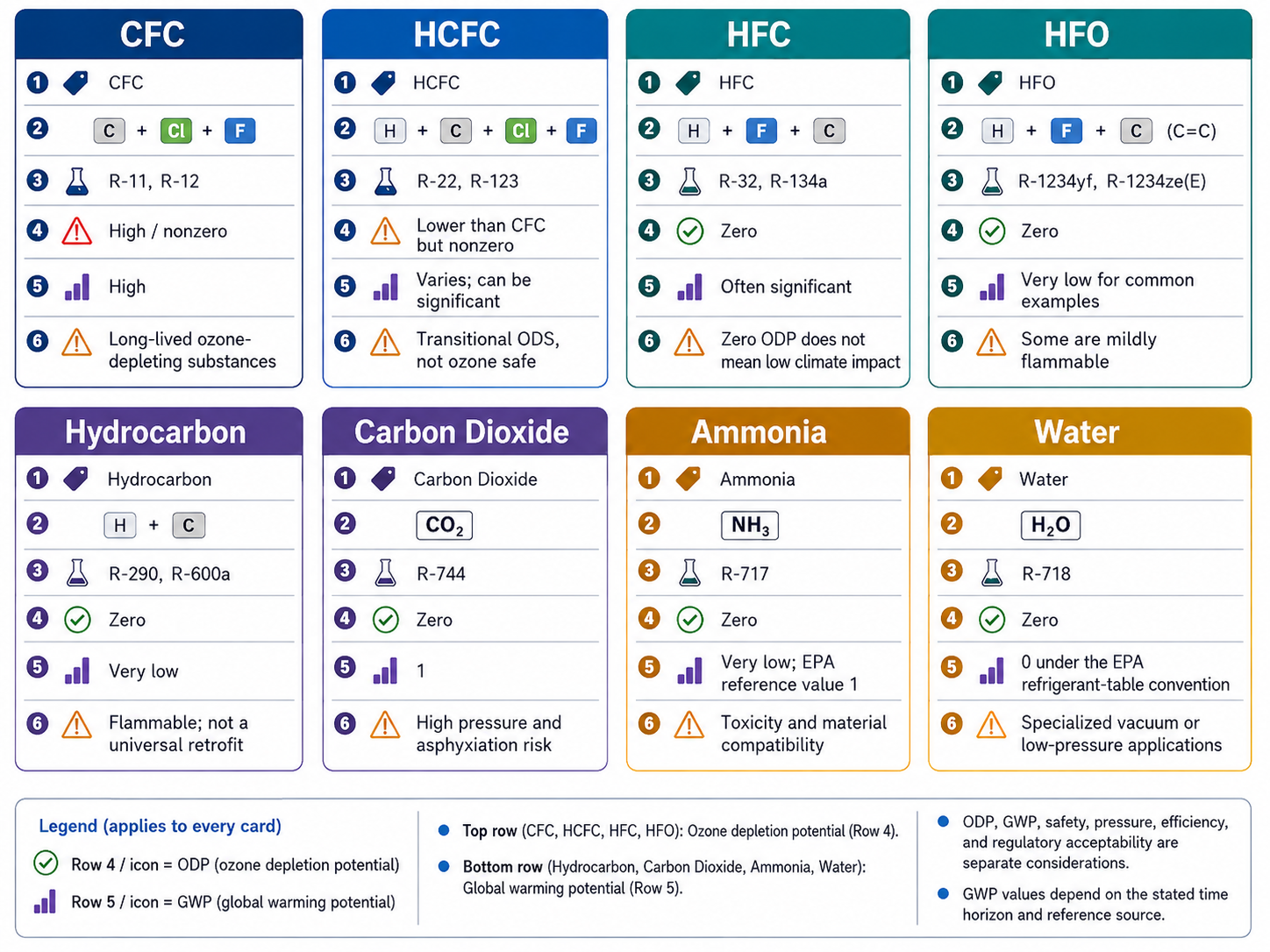
Figure 2.3.1 – Chemical composition and environmental comparison of major refrigerant families.
AI-generated instructional figure: It may contain visual inaccuracies. Use the accompanying lesson text and cited authoritative sources to verify technical and regulatory details.
EPA 608 Exam Focus
What Students Must Remember
- CFC: carbon, chlorine, and fluorine.
- HCFC: hydrogen, carbon, chlorine, and fluorine.
- HFC: hydrogen, fluorine, and carbon; no chlorine.
- HFO: unsaturated fluorinated compound with a carbon-carbon double bond.
- CFCs generally have significant ODP and high GWP.
- HCFCs have lower but nonzero ODP.
- HFCs have zero ODP but may have high GWP.
- Common HFOs have zero ODP and low GWP.
- Hydrocarbons have zero ODP and low GWP but are flammable.
- R-744 is carbon dioxide.
- R-717 is ammonia.
- R-718 is water.
- ODP is referenced to CFC-11.
- GWP is referenced to carbon dioxide.
- GWP requires a time horizon and source.
- Zero ODP does not mean zero GWP.
- Low GWP does not mean no hazard.
- SNAP acceptability is end-use specific.
- A refrigerant family does not determine retrofit suitability.
Typical Exam Question Patterns
Students may be asked to:
- Identify the elements in a refrigerant family.
- Select the family with zero ODP but potentially high GWP.
- Identify the ODP reference substance.
- Identify the GWP reference substance.
- Compare CFCs and HCFCs.
- Explain why HFC-134a is ozone safe but not climate neutral.
- Identify R-290, R-717, R-744, or R-718.
- Identify a hydrocarbon or ammonia safety concern.
- Determine whether low GWP proves retrofit acceptability.
- Explain why two sources list different GWP values.
- Calculate blend GWP from component mass fractions.
- Distinguish direct and indirect climate effects.
High-Priority Family Comparison
| Exam Clue | Best Association |
|---|---|
| Carbon + chlorine + fluorine | CFC |
| Hydrogen + carbon + chlorine + fluorine | HCFC |
| Hydrogen + fluorine + carbon, no chlorine | HFC |
| Carbon-carbon double bond | HFO |
| Zero ODP, often significant GWP | HFC |
| Zero ODP, very low GWP, flammable | Hydrocarbon |
| R-744 | Carbon dioxide |
| R-717 | Ammonia |
| R-718 | Water |
| ODP reference | CFC-11 |
| GWP reference | Carbon dioxide |
Common Mistakes and Confusing Points
Mistake 1: Assuming Every Fluorinated Refrigerant Depletes Ozone
Fluorine alone is not the controlling issue. HFCs and HFOs contain fluorine but no chlorine and have zero ODP.
Mistake 2: Assuming HCFCs Have Zero ODP
HCFCs still contain chlorine and have nonzero ODP.
Mistake 3: Assuming HFC Means Low GWP
Many HFCs have significant or high GWP.
Mistake 4: Treating HFC and HFO as Identical
HFOs contain a carbon-carbon double bond that generally shortens atmospheric lifetime.
Mistake 5: Assuming Zero ODP Means Environmentally Harmless
A zero-ODP refrigerant can have high GWP, flammability, toxicity, high pressure, or indirect energy effects.
Mistake 6: Comparing GWP Values Without Checking the Basis
The time horizon, assessment, and regulatory table must be identified.
Mistake 7: Calling Carbon Dioxide a Zero-GWP Refrigerant
Carbon dioxide is the reference gas and has GWP 1.
Mistake 8: Assuming Every Natural Refrigerant Is Nonflammable and Nontoxic
Hydrocarbons are flammable. Ammonia is toxic. Carbon dioxide creates high-pressure and exposure hazards.
Mistake 9: Treating Low-GWP Refrigerants as Universal Drop-In Replacements
Compatibility, pressure, lubricant, safety, charge limits, codes, and SNAP conditions must be evaluated.
Mistake 10: Using Chemical Family as a Safety Classification
Safety class must be checked for the specific refrigerant or blend.
Concept-Check Questions
Question 1
Which elements are present in an HCFC refrigerant?
A. Hydrogen, carbon, chlorine, and fluorine
B. Hydrogen, fluorine, and carbon only
C. Carbon and oxygen only
D. Nitrogen and hydrogen only
Question 2
Which substance is the reference for ozone-depletion potential?
A. Carbon dioxide
B. CFC-11
C. HFC-134a
D. Ammonia
Question 3
Which substance is assigned a global-warming potential of 1 as the reference gas?
A. CFC-12
B. HCFC-22
C. Carbon dioxide
D. Water
Question 4
Which statement about HFC refrigerants is most accurate?
A. They contain chlorine and always have high ODP.
B. They have zero ODP, but many have significant GWP.
C. They are hydrocarbons containing only hydrogen and carbon.
D. They are always nonflammable and acceptable for every application.
Question 5
Why do common HFO refrigerants generally have lower GWP than many saturated HFC refrigerants?
A. They contain chlorine that destroys greenhouse gases.
B. Their carbon-carbon double bond generally increases lower-atmosphere reactivity and shortens atmospheric lifetime.
C. They are identical to carbon dioxide.
D. They cannot absorb infrared radiation.
Question 6
Which pairing is correct?
A. R-290 — ammonia
B. R-717 — carbon dioxide
C. R-744 — carbon dioxide
D. R-718 — propane
Question 7
Which statement best explains why zero ODP does not mean zero environmental effect?
A. Zero-ODP refrigerants always destroy ozone through bromine chemistry.
B. A refrigerant may have zero ODP but still have high GWP, safety hazards, or indirect energy impacts.
C. ODP and GWP are two names for the same measurement.
D. A zero-ODP refrigerant is automatically acceptable as a retrofit in every system.
Question 8
Why might two technically credible references list different GWP values for the same refrigerant?
A. GWP values never use a reference substance.
B. GWP can depend on the time horizon, scientific assessment, and regulatory reference adopted.
C. Refrigerant composition changes when a table is printed.
D. ODP is added to GWP in newer references.
Answers and detailed explanations will be provided in
2.11 - Answers and Explanations.md.
Section Summary
Refrigerant families are distinguished by chemical composition and structure:
- CFCs contain carbon, chlorine, and fluorine.
- HCFCs contain hydrogen, carbon, chlorine, and fluorine.
- HFCs contain hydrogen, fluorine, and carbon without chlorine.
- HFOs contain hydrogen, fluorine, and carbon with a carbon-carbon double bond.
- Hydrocarbons contain hydrogen and carbon only.
- R-744 is carbon dioxide.
- R-717 is ammonia.
- R-718 is water.
ODP compares a substance with CFC-11. GWP compares a substance with carbon dioxide over a stated time horizon.
The broad pattern is:
- CFCs: significant ODP and high GWP.
- HCFCs: lower but nonzero ODP and varying GWP.
- HFCs: zero ODP but often significant GWP.
- HFOs: zero ODP and generally low GWP.
- Hydrocarbons: zero ODP and low GWP, with flammability concerns.
- Carbon dioxide: zero ODP and GWP 1, with pressure and exposure concerns.
- Ammonia: zero ODP and very low direct climate impact, with toxicity concerns.
- Water: zero ODP and GWP 0 under the EPA refrigerant-table convention, with specialized application limits.
A refrigerant must not be evaluated by ODP or GWP alone. Safety, efficiency, pressure, compatibility, service procedures, codes, and current regulatory acceptability also matter.
References
Current EPA and Regulatory Sources
-
U.S. Environmental Protection Agency, Ozone-Depleting Substances, accessed August 6, 2026.
-
U.S. Environmental Protection Agency, Phaseout of Class I Ozone-Depleting Substances, accessed August 6, 2026.
-
U.S. Environmental Protection Agency, Phaseout of Class II Ozone-Depleting Substances, accessed August 6, 2026.
-
U.S. Environmental Protection Agency, Technology Transitions GWP Reference Table, accessed August 6, 2026.
-
U.S. Environmental Protection Agency, Compositions of Refrigerant Blends, accessed August 6, 2026.
-
U.S. Environmental Protection Agency, Refrigerant Safety, accessed August 6, 2026.
-
U.S. Environmental Protection Agency, Relevant EPA Programs — GreenChill, accessed August 6, 2026.
-
U.S. Environmental Protection Agency, Substitutes in Refrigeration and Air Conditioning, accessed August 6, 2026.
-
Electronic Code of Federal Regulations, 40 CFR Part 84 — Phasedown of Hydrofluorocarbons, accessed August 6, 2026.
-
Electronic Code of Federal Regulations, 40 CFR § 84.64 — Global Warming Potentials, accessed August 6, 2026.
Current Scientific Sources
-
World Meteorological Organization, Scientific Assessment of Ozone Depletion: 2022, annex containing atmospheric lifetimes, ODPs, and GWPs.
-
Intergovernmental Panel on Climate Change, Climate Change 2007: The Physical Science Basis, values incorporated into specified EPA regulatory tables.
EPA 608 Examination Reference
- U.S. Environmental Protection Agency, Section 608 Test Topics, accessed August 6, 2026.